
Jan 3, 2026 • Adrian T
AEO vs. GEO: The Marketer's Guide to AI-Driven Search Optimization
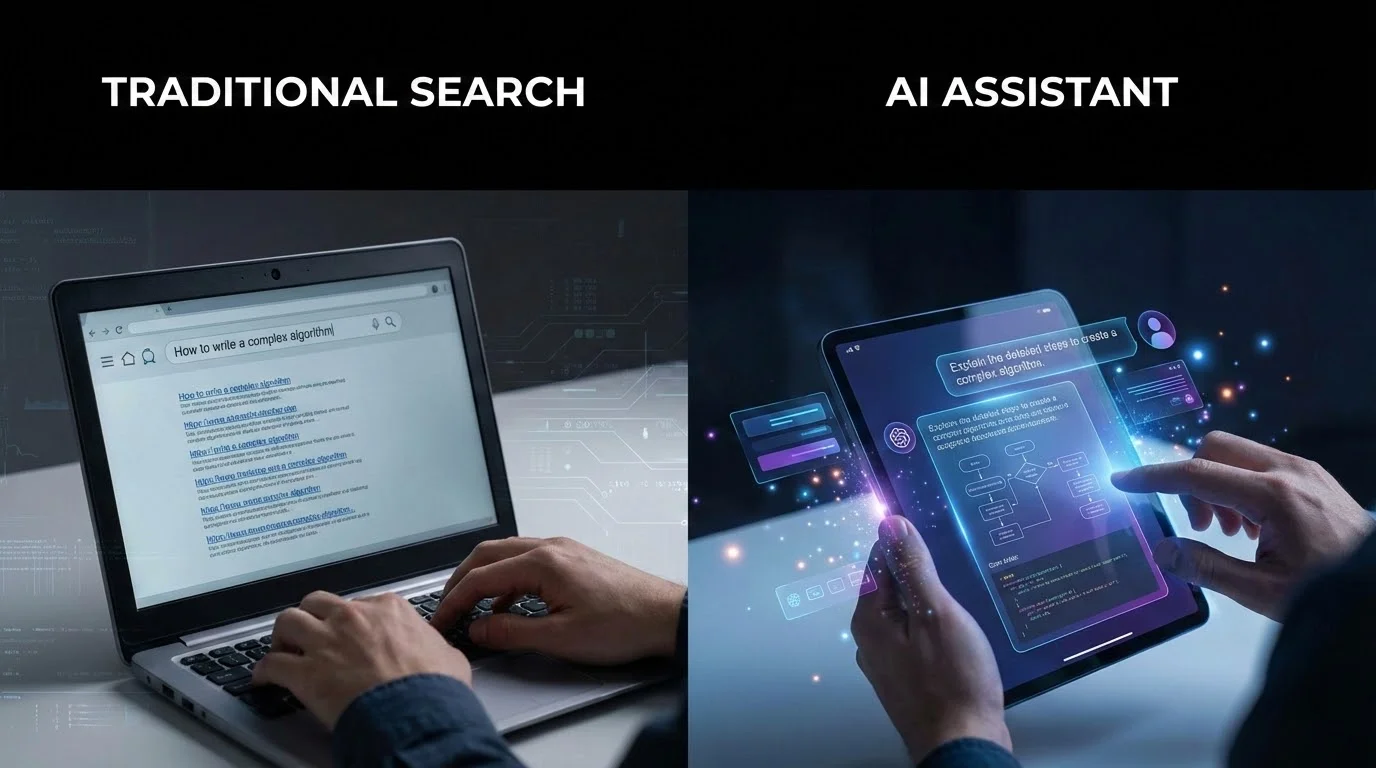
Search is changing at a speed that makes a lot of people nervous. Most of us don't want to dig through a list of ten blue links anymore. We just want the answer. This shift is forcing marketers to move past traditional SEO. We have to learn Answer Engine Optimization (AEO) and Generative Engine Optimization (GEO). These two frameworks are the new map for digital visibility. If you understand them, your brand becomes the expert. If you don't, you disappear. This guide explains the differences and why your current content strategy probably needs a total rewrite.
The Shift from Traditional SEO to AI Search
For twenty years, SEO was a simple game of keywords and backlinks. You optimized a page and hoped for a spot on page one. That model is falling apart. People are moving away from searching and finding. They're moving toward prompting and receiving.
Why the 'Search Result Page' is Evolving
The search page is turning into a dashboard. It's no longer just a directory of websites. When you search for something now, you often get a big block of AI text or a snippet that answers you instantly. Google calls this the Search Generative Experience.
This is happening because people are busy. They don't want to click on three different sites to compare two products. They want the AI to do the heavy lifting. This means the space on the first page is getting smaller. If your content isn't feeding these AI summaries, you're losing your audience. The interface is turning into a conversation. Your content has to be ready to talk back.
The Impact of AI on Organic Web Traffic
We're entering the age of the zero-click search. This happens when a user gets what they need without ever leaving the search page. It's a nightmare for some publishers. Organic traffic for simple questions is definitely dropping because the AI just gives the answer away.
But there's a silver lining. The people who do click through to your site are usually more interested. If someone reads an AI summary and still clicks your link, they want real depth. Success isn't about raw hit counts anymore. It's about being the source of truth that the AI trusts most.
Understanding Answer Engine Optimization (AEO)
AEO is the art of being the definitive response to a specific question. It bridges the gap between old-school SEO and the new AI world. It focuses on facts that are short and easy to digest.
Optimizing for Direct Answers and Voice Assistants
Voice search was the first big test for AEO. When you ask a smart speaker for a recipe, it only gives you one result.
There's no second place in voice search.
To win here, your writing has to sound natural when it's read out loud. Get to the point immediately. If you're explaining how to calculate ROI, put the formula in the very first sentence. Don't hide the answer behind three paragraphs of fluff about the modern business landscape. AI engines want the fastest path to the answer. If you provide that path, you're the one the AI will quote.
Technical Requirements: Schema Markup and Structured Data
We can't ignore the technical side. Search engines are smart, but they like it when you label your data clearly. Schema markup is basically a map for bots. It tells the engine exactly what a piece of text is.
If you have a review, use review schema. If you have a physical store, use local business schema. This makes it easier for an engine to verify your facts. It removes the friction of trying to understand your page. Many sites skip this. That's a huge mistake. Even if your content is better, a bot might choose a competitor just because their data was easier to read.
The Role of FAQ Sections in Winning Featured Snippets
FAQs are one of your best tools. They're already built in a question and answer format. This is exactly what AI engines look for. By putting a good FAQ at the bottom of your articles, you're giving the search engine a cheat sheet.
Try to keep your FAQ answers between 40 and 50 words. This is the sweet spot for Google snippets. Use simple language. If you can provide a clearer answer than the current winner, the engine will often pick yours instead. It's a constant fight for that top spot.
Understanding Generative Engine Optimization (GEO)
GEO is a newer concept. It focuses on how models like ChatGPT and Perplexity combine information. AEO looks for one answer. GEO is about making sure your brand is part of the story when an AI writes a long summary.
How LLMs Synthesize and Cite Sources
AI models don't just find your page. They read millions of pages and look for patterns. When a user asks a complicated question, the engine pulls from several sources to build a response.
Citations are the new backlinks.
In a Perplexity search, you'll see little footnotes. Those links lead to the sources. To get those footnotes, you have to say something unique. If you're just repeating what everyone else says, the AI will treat your words as general knowledge. You won't get a citation for that. You need a fresh angle or a specific data point.
The Importance of Brand Citation and Authority
In GEO, your reputation is everything. These engines prefer sources they can trust. If your brand shows up on other reputable sites, the AI learns that you're an expert. This creates a loop that keeps building your authority.
You want the AI to think of your brand when certain topics come up. If someone asks for the best project management tool, you want to be on that list. This requires a big digital footprint. It isn't just about what's on your own site. It's about how the rest of the internet talks about you. The AI is always listening to the global conversation.
Why Original Research is Critical for GEO Success
Original research is a gold mine for GEO. AI models love hard data. When you publish a study or a survey, you're offering something that doesn't exist anywhere else.
Imagine you publish a report on the 2024 state of marketing. Every time an AI explains a marketing trend, it has a high chance of citing your specific stats. This makes you a primary source. Primary sources are the biggest winners in generative search. If you can become the main source for your niche, you've basically won the game.
Key Differences: AEO vs. GEO Explained
AEO and GEO share some DNA, but they're different beasts. AEO is about being the answer. GEO is about being the source.
Think of AEO as a quick interaction. The user wants a fact or a time. The goal is speed. GEO is more like a conversation. It's for when a user wants a comparison or a long explanation.
The platforms are different too. AEO is mostly about Google snippets and voice assistants. GEO is about the new wave of AI chat interfaces. You have to balance both. If you only focus on quick facts, you'll miss out on the brand building that comes with deep citations.
Practical Strategies for Modern Marketers
The landscape is changing, but don't panic. You just need to adapt. Practical strategies for now involve a mix of technical work and creative authority. You should probably go back and rewrite your old content to fit these new rules.
Building a Multi-Layered Content Framework
A good page today has to serve two bosses. It needs to give the AI a quick summary and give the human reader a deep dive. This is a layered approach.
Put a TL;DR summary at the very top of your posts. This gives answer engines a clear target to grab. Under that, provide the deep analysis that builds your GEO authority. This makes your content useful for everyone. Whether someone is using a quick voice command or doing an hour of research, you're giving them value.
Leveraging Micro-Eponyms and Niche Authority
A micro-eponym is just a fancy way of saying you should name your ideas. If you create a specific process, give it a unique name.
When people and AI start using that name, you become the definitive source for it. It's a way to own a small piece of the digital world. Don't just talk about being productive. Talk about your specific Productivity Sprint Method. Once the AI learns the name, it has to credit you.
Adapting to the 'Zero-Click' Reality
Zero-click is a reality now. Instead of fighting it, use it for brand awareness. Sometimes the goal isn't the click. It's the impression.
If a user sees your brand name cited in an AI answer, that's a win. You want your brand to be inseparable from the value you provide. If an AI summarizes your advice but leaves your name out, you just gave the search engine free labor. Write in a way that weaves your brand's perspective into the facts. This makes it harder for the AI to strip your name away.
Future-Proofing Your Digital Visibility for 2026 and Beyond
Looking ahead, the line between search and assistant will disappear. By 2026, we'll likely have AI agents that book our flights or buy our groceries. To survive that, you have to be more than just a blogger. You have to be a trusted entity.
Focus on building a real community. AI can summarize facts, but it can't copy human trust. The more people search for your brand by name, the more the AI will prioritize you. Future visibility isn't about tricking an algorithm. It's about being so important to your niche that the algorithm can't ignore you.
Conclusion
Moving from SEO to AEO and GEO is a massive change in how the internet works. AEO handles the what and the how. It gives quick answers to people in a hurry. GEO handles the why and the who. It weaves your brand into the complex stories told by AI models. You need to master both. By keeping your content clear, labeling it properly, and doing your own research, you stay in the lead. The search engines of the future don't just want links. They want the truth. If you give them the truth in a way they can understand, you'll stay visible.
FAQ
What is the main difference between AEO and GEO?
AEO is for quick, direct answers, usually for voice search or snippets. GEO is for getting your brand cited in long AI summaries written by models like ChatGPT.
Does GEO replace traditional SEO practices?
No. It builds on them. You still need a fast site and good writing. But now you also need brand authority and unique data that AI wants to use.
How can I track the performance of my content in AI generative engines?
Google Search Console is starting to show some AI data. You can also search for your main topics in Perplexity or ChatGPT to see if they're citing you.
Why are citations more important than backlinks in the age of AI?
Backlinks still help your rank, but citations in an AI response directly tell the user you're an expert. If the AI doesn't mention you, the user might never know you provided the information.
Which tools can help me optimize for Answer Engines?
Schema generators are essential for your data. You can also use tools like Semrush or Ahrefs to find snippet opportunities. Looking at the People Also Ask section on Google is a great way to find the questions you need to answer.
Related Posts

Is Blogging Dead in 2026? The Ultimate Guide to Starting a Profitable Blog Today

Technical SEO for Developers: Building a High-Performance Foundation

How to Write SEO Content That Ranks High: A Comprehensive Guide

Unlock Your Potential: A Treasure Trove of FREE AI Tools at Your Fingertips!

How to Delete a page in Google Docs

How to change Margins in Google Docs

Essential Google Docs Shortcuts to Save Time

The Entrepreneurial Leap: When Your Intrapreneurial Spirit Yearns for More
